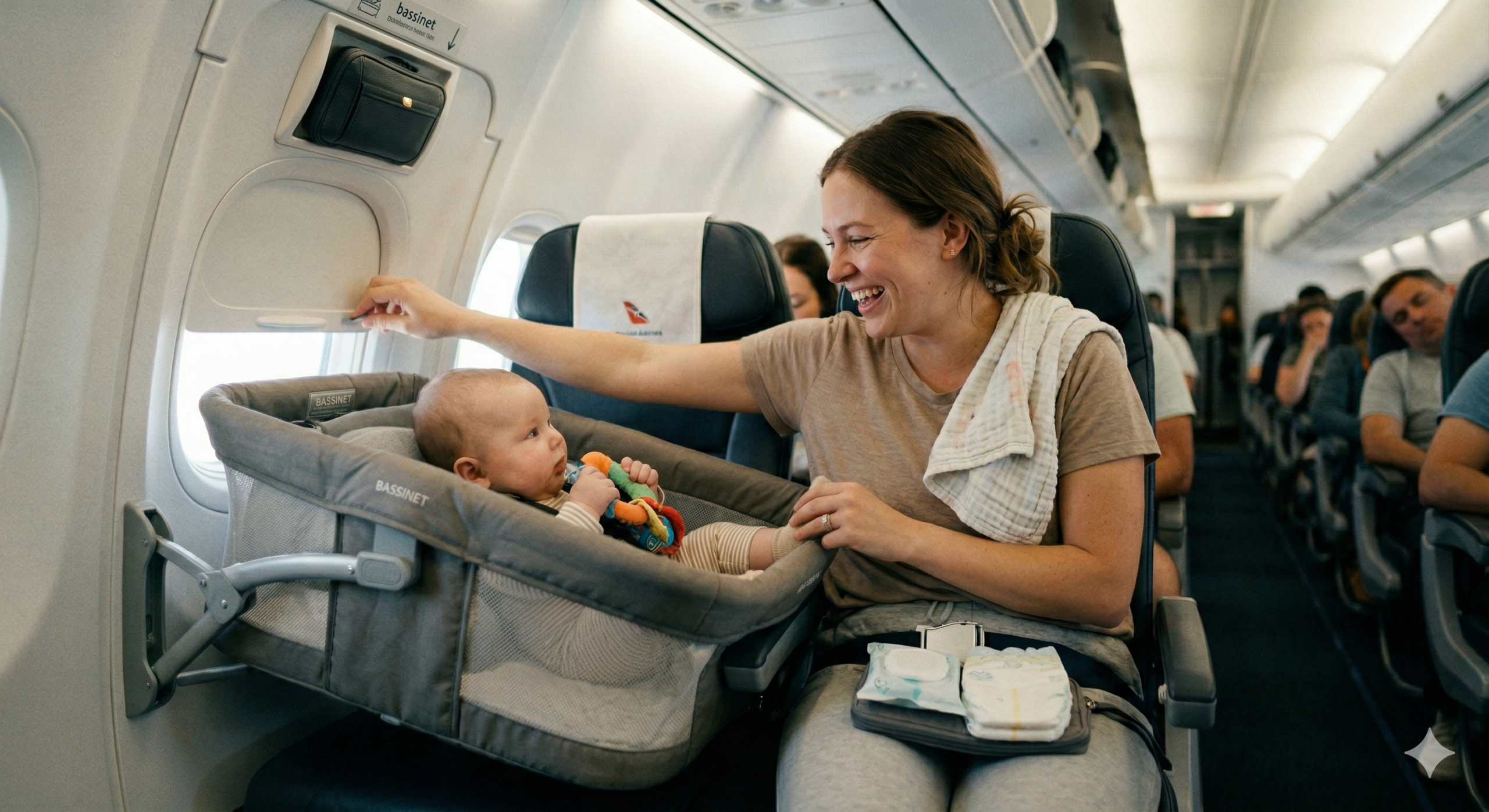
No one warns you about the absolute terror of flying with a baby for the first time! We were totally caught off guard by how challenging it was to travel with our 4-month-old. We even tried to start small—a simple boat trip to a nearby country from Singapore—and it was still a struggle. Between the extra luggage, the bulky stroller, and the constant mental checklist, the stress was real. To help you avoid the same chaos, we’ve put together our top must-have baby travel essentials.
1. Always request a bassinet seat in advance (make sure that you baby is within the height and weight restrictions for the bassinet)
If you are flying, this is the single biggest thing you can do before you even get to the airport. Most airlines on long-haul flights offer bassinet seats — bulkhead rows where a small cot clips onto the wall in front of you. Your baby sleeps in the bassinet instead of on your lap for the entire flight. Your arms are free. Your lap is free. You can actually eat a meal with both hands.
If your baby is already on a sleep training schedule, the bassinet makes it much easier to maintain that routine mid-flight.
The catch? There’s usually only one or two bassinets per cabin section, and they go fast. You need to call the airline directly and request one as early as possible — ideally the moment you book your tickets.
What you need to know before requesting:
- Every airline has a height and weight restriction for the bassinet. Most cap it at around 10–11kg and 70–75cm. If your baby is close to the limit, check the specific airline’s policy before you assume it’ll work.
- Some airlines let you reserve online. Others require a phone call. A few only confirm at check-in, which is stressful but still worth requesting.
- The bassinet attaches to the bulkhead wall, which means you’ll be in the front row. More legroom, but no under-seat storage — everything goes in the overhead bin. This would relate to our last point below on boarding early to ensure you get space for your overhead bin. Otherwise it will be a hassle to wake in the middle of the night, in the dark, walk along the aisle to reach your diaper bag or your milk bag.
- Bring your own bassinet sheet or your baby’s favourite toy. Our son had a favourite toy that he carries to sleep every night and it will be beneficial for him to have it as well in the bassinet as it is a new sleeping environment and having that familiar smelling sheet or toy can help hi to settle faster in an unfamiliar sleeping space.
2. Have milk prepared for takeoff and landing to reduce air pressure
This one is about ear pressure, and it makes a bigger difference than most parents realise. As the plane climbs and descends, the cabin pressure changes rapidly. Adults equalise by swallowing, yawning, or popping their ears. Babies can’t do this on their own. Their Eustachian tubes are smaller and less developed, which means pressure builds up and causes genuine pain. That pain is why so many babies scream during takeoff and landing. Not because they’re scared of the plane. Because their ears hurt.
The fix is simple: feeding. Nursing, bottle-feeding, or even a pacifier — anything that encourages your baby to swallow repeatedly helps equalise the pressure naturally.
How to time it right
- Takeoff: Start feeding as the plane accelerates down the runway. Not when you board. Not during the safety demonstration. When the engines power up and you feel the plane moving — that’s when you offer the bottle or breast.
- Landing: This is trickier because the descent starts 20 to 30 minutes before touchdown. Listen for the captain’s announcement or watch for the seatbelt sign. Start feeding when you feel the plane beginning to drop. If you start too early, the baby might finish the bottle before the real pressure change kicks in — so pace it.
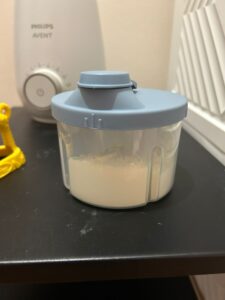
- Bring more milk than you think you need. Delays happen. Flights get diverted. Layovers extend. The general rule is one bottle per 2 to 3 hours of travel, plus two extras. If you’re formula feeding, pre-measure the water into separate bottles so all you have to do is add the powder. Alternatively, you can also ask the flight attendant for water during the flight but we find it less assuring since there could be turbulence during the flight and the attendant may not be able to assist you then. Hence we will pre-fill his bottles at the airport after security checks (but you don’t have to wait until past the security checks since you are exempt from the 100ml liquid rule with a baby). We also carry this very handy container that we measure to 120ml (for our 4 month old son) for each compartment and we just empty that compartment fully into the pre-filled bottle.
3. Change his diapers just before boarding
This sounds so obvious that you might skip right past it. Don’t.
The window between the last diaper change and when you’re actually seated on the plane is longer than you think. By the time you’ve queued at the gate, walked down the jet bridge, shuffled to your seat, loaded the overhead bin, and strapped in — that’s easily 20 to 30 minutes. Add a delay on the tarmac and you’re looking at an hour.
If you changed the diaper an hour before boarding, you’re now starting the flight with a diaper that’s already halfway full. And changing a diaper in an airplane bathroom — if the plane even has a changing table — is one of the most stressful experiences in parenting. The space is tiny. There’s turbulence. Everything is damp. The baby is screaming. You’re contorted into a position that would challenge a yoga instructor.
4. Bring a Change of Clothes — for the Baby AND for You
Everyone tells you to pack spare clothes for the baby. Nobody tells you to pack a spare shirt for yourself. Let me paint the picture. You’re two hours into the flight. The baby has a blowout. A proper, up-the-back, out-the-sides, defying-the-laws-of-physics blowout. You were carrying him and shushing him to sleep when you had these all over you from the baby’s soiled clothes and onto you and after changing him into a fresh set you got the stain over you and have got a few more hours of sitting in that seat in that shirt before you land. It will feel so uncomfortable.
What to pack
- 2 to 3 full changes for the baby. Not just onesies. Full outfits — top, bottom, socks. Blowouts don’t respect clothing boundaries. And spit-up can soak through layers.
- 1 spare top for yourself. A dark-coloured t-shirt that rolls up small. Dark colours hide stains better. Keep it in a ziplock bag so it stays clean and compressed.
- Nappy bags or scented disposal bags. For containing the dirty clothes until you can deal with them. Nobody on that plane needs to smell what just happened.
Keep the spare clothes in an easy-access part of your carry-on — not buried at the bottom of the bag. When a blowout happens at 35,000 feet, you don’t have time to unpack everything. You need to grab and go.
5. Bring a Portable Sterilizer and a Baby Carrier
When you’re traveling, carrying a portable sterilizer in your luggage will be critical. As you go through the bottles during the day, you will end up having a lot of used bottles at the end of the day that you will have to wash and get them sterilized and dried for usage again at night before your baby goes to bed. Having that portable sterilizer will be important so that you can efficiently sterilize your bottles instead of doing a manual boiling and sterilizing. The last thing you want at the end of a long day, is a wailing baby and being stressed out because the bottles are not ready.
And if you want a portable sterilizer that sterilizes and dries , check out the best bottle sterilizers.
A baby carrier is also very important when traveling. It straps your baby securely to your chest so you can handle everything else. Both hands free. Baby is calm and close to you. You can navigate the airport, manage luggage, show your boarding pass, and go through security without doing the desperate one-handed juggle that every parent knows too well. Also, most airports have long walks between security and the gate. Carrying a baby in your arms for 15 minutes through a crowded terminal while pulling a suitcase is a recipe for a meltdown — yours, not the baby’s. Our baby loves being in a carrier and he sleeps better when in one. He also dislikes being in a stroller thus having a carrier is a lifesaver if not we could end up carrying him the entire journey in our arms.
6. Bring inflatable baby bathtub for bathing
This is the baby travel essential that nobody talks about, and the one that surprised me the most.
Hotel bathtubs are huge. They’re slippery. They’re not designed for bathing a small baby who can’t sit up yet. And sinks — even if they’re big enough — are unhygienic and awkward.
The first time we tried to bathe our baby in a hotel, it was a disaster. I was kneeling on a cold tile floor, one hand supporting his head, the other trying to wash him, water splashing everywhere, terrified he’d slip. My husband stood behind me holding a towel and looking equally helpless.
An inflatable baby bathtub solves this completely. It’s lightweight, packs flat in your suitcase, inflates quickly, and gives your baby a safe, contained space for bath time — anywhere. Being a first time user of the inflatable bathtub, I was manually pumping air into the bathtub so that it expands like a float. It took about 10 minutes to inflate it manually, not too bad. The issue was deflating it. We chose to deflate it only the next day morning so that we could dry the bathtub efficiently in its proper shape. But deflating it was a challenge as we had to squeeze it systematically from one area to another, and not just squeezing it with force anywhere. It doesn’t work that way. So this means that you will need to take awhile to fully deflate it. It took me around 20 minutes the first time. So, when you are packing up everything in the morning before leaving for the day, you can imagine how much of a rush you could be in.
So, plan your time in the day and set aside huge buffers. The inflatable bathtub is non-negotiable as I can’t see any way around not having one.
7. Split the Boarding — One Parent First, Baby Boards Last
This is the strategy that changed everything for us, and I’ve never seen it in a packing list because it’s not about what you bring — it’s about how you board. Most airlines offer priority boarding for families with young children. And most parents take it. They board first, get settled, and wait for everyone else to file past.
Here’s the problem with that: your baby is now sitting on a stationary, stuffy plane for an extra 20 to 30 minutes while the rest of the passengers board. No entertainment. No movement. Nothing happening. Just waiting. And babies don’t wait well. By the time the plane actually starts taxiing, your baby is already bored, restless, and possibly crying. You’ve burned through 30 minutes of patience before the flight has even started.
The strategy that works:
- One parent boards first — with the luggage, stroller (to gate-check), car seat if you have one, and the carry-on bags. This parent claims the overhead bin space, sets up the seat area, gets the tray table organised, and makes sure everything is ready.
If you’re still looking for the right travel stroller, our guide on the best strollers that fold small covers the most compact options for flying.
Not sure which stroller type is right for your family? Start with our complete stroller buying guide.
- The other parent stays in the terminal with the baby. Let the baby crawl around. Walk them in the carrier. Feed them. Change the diaper one last time if needed. Keep them stimulated and happy in the terminal where there’s space and things to look at.
- The second parent boards last — or as close to last as possible. Walk onto the plane, sit down, and the doors close almost immediately. Minimal waiting time on the plane. Maximum patience preserved.
This means your baby spends as little time as possible sitting in a confined airplane seat before takeoff. And those 20 to 30 minutes of patience you just saved? You’ll need every single one of them during the actual flight.
What We’d Tell First-Time Flying Parents
Looking back at our first flight, the biggest mistake wasn’t what we packed. It was that we had no plan for how the day would actually unfold. We packed for every scenario but didn’t think through the sequence — when to feed, when to change, when to board, how to divide responsibilities.
The seven things on this list aren’t just baby travel essentials in the traditional sense. Half of them aren’t even things you buy. They’re strategies. Timing. Coordination. Small decisions that add up to a dramatically different experience.
Your first flight with a baby will probably still be stressful. Ours was. But the difference between chaotic-stressful and manageable-stressful is having a plan — and the right essentials to back it up. You’ve got this. And if the baby cries? So does every baby on every plane. The passengers around you have been there or they’ll get there eventually. Nobody is judging you as harshly as you’re judging yourself.
Pack smart. Plan the timing. And enjoy the adventure — you’re taking your baby to see the world.
If you’re still in the early newborn phase, you might also want to read 5 things no one told me before having a baby — because flying isn’t the only thing nobody prepares you for.

3 Comments