I read every book. I took the prenatal class. I had a birth plan, a hospital bag checklist, and a nursery that was Pinterest-ready three weeks before my due date. None of it prepared me for what actually happened after having a baby.
Everyone warns you about the sleepless nights and the dirty diapers. But there are things — raw, uncomfortable, nobody-talks-about-this things — that blindsided me completely. I wanted to share my experiences that I learnt along the way only after I had given birth. These were also why I grew through this process mentally, physically and learnt to be a mother. So whether you’re pregnant right now, planning to start a family, or in the thick of those early weeks wondering if you’re the only one struggling — you’re not. Here are the top 5 things I wish someone told me before I had my baby.
You bleed for weeks after giving birth
After delivery — whether vaginal or C-section — you experience something called postpartum bleeding (lochia). I’m not talking about light spotting. I’m talking about 6 to 8 weeks of heavy bleeding that starts immediately after birth and only gradually tapers off.
The first few days were the worst. I was going through maternity pads at a rate I didn’t think was possible. I remember standing in the hospital bathroom, looking down, and genuinely panicking because I thought something was wrong. The midwife assured me it was normal. But “normal” doesn’t mean “expected” — not when nobody warned you. You should stock up on those maternity pads because you will need it more than you think. I packed two small packs in my hospital bag. I needed six. Buy at least three large packs of heavy-duty maternity pads before your due date. Regular period pads won’t cut it in those early days.
The bleeding changes colour and that’s normal. It starts bright red and heavy (like a very intense period with clots), then shifts to pinkish-brown over the next few weeks, and eventually becomes a yellowish-white discharge. This progression is your body healing — it’s a good sign. If you find yourself soaking through a pad in an hour or less, passing clots larger than a golf ball, or a sudden increase in bleeding after it had been slowing down — these are warning signs. Don’t wait. Call your midwife or doctor immediately.
Breastfeeding is hard
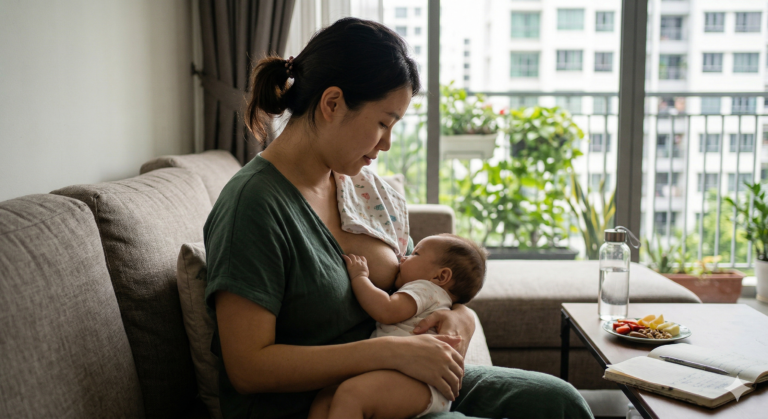
I thought it would be natural and instinctive but I was wrong. The first time I tried to latch my baby, he did not want to latch. I was taught in prenatal class the various positions to latch a baby but when it came the time to latch, it was definitely not straightforward. Holding a newborn who seem so fragile and squirming at the same time just compounds the difficulty in getting him to the position you want. When he is just bawling away at the top of his voice increases the stress and anxiety on you when you are already so weakened with the delivery.
It takes time to learn how to breastfeed and get your baby to have a good latch. And when you finally got him to the position you want, he takes only a small bit and you worry if he took enough.
Then there was pumping. Every 2 to 3 hours, around the clock. Setting an alarm at 2am when you’ve only just fallen asleep. Sitting with a pump attached to your chest for 20 to 30 minutes. Washing pump parts. Labelling and storing milk. Falling back into bed. Then the alarm goes off again.
If you’re pumping or bottle feeding, you’ll also want a reliable way to keep things clean — here’s our guide to the best bottle sterilizers.
If you’re pumping multiple times a day, an all-in-one bottle sterilizer that washes, sterilizes, and dries can save you hours every week.
I remember one night — maybe day 10 or 11 — I was pumping at 3am in the dark. The baby was finally asleep. My husband was asleep. And I just sat there with tears running down my face, too exhausted to even wipe them. Not because anything was specifically wrong. Just because the relentlessness of it hit me all at once.
Nobody prepared me for the emotional weight of it. Not just the physical exhaustion, but the mental load of tracking ounces, timing feeds, worrying about supply, and questioning whether you’re doing it right — all while your body is still healing from birth. Having a baby is a bundle of joy but the work and emotions that comes with it should not be underestimated.
What actually helped me with breastfeeding
Book a lactation consultant before the baby arrives. Don’t wait until you’re struggling. Many hospitals offer free LC consultations in the first 48 hours. A good consultant can spot latch issues immediately and show you adjustments that make a world of difference. This was the single best thing I did.
Nipple cream after every single feed. Lanolin or a good nipple balm — apply it religiously after every feed in the early weeks. It won’t fix a bad latch, but it helps your skin heal between feeds.
Around week 4 to 6, something shifts. I know this sounds hollow when you’re in the worst of it. But for me, and for many mums I’ve spoken to, there’s a turning point. The latch improves. Your supply regulates. Feeds get faster. It doesn’t happen overnight, but it does happen.
Creating diaper stations around the house helps a lot
This one saved me. Don’t just have one changing spot in the whole house. Having a baby means you should ideally set up mini stations everywhere and duplicate the items. Here’s what happened.
Ever since we moved back with our parents when our newborn arrived, we lived in a 2 storey house. The diaper changing station was upstairs in our bedroom. During the day. my husband is usually working in office and I would be home taking care of our little one. I would usually be downstairs in the living room. Once I was alone and had a blowout in the living room, I had to scramble upstairs to get a fresh set of diapers while leaving my newborn downstairs and rushed back down with it. Then later, I realised that I forgot about his diaper cream and rushed back up to get it.
When you’re running on 2 hours of sleep, you tend to be a little forgetful and not as efficient. You want to make it as straightforward as possible for yourself especially if you’re living in a big house and are managing it all alone.
Side lying breastfeeding changed my life
For the first few weeks, I did every single feed in the cradle hold position. Sitting upright. Baby in my arms. Hunched forward trying to get the angle right. My back was on fire. My arms ached constantly. My shoulders felt like they were locked in a permanent forward curl. I started getting tension headaches from the posture. I needed my husband to massage my shoulders each time I did this position as I was just getting too much tension on my shoulders.
And night feeds? Night feeds were torture. Dragging myself upright at 2am, propping pillows behind me, trying to stay awake for 30 to 40 minutes while the baby fed. I was so tired that I would catch myself nodding off while sitting up, head snapping forward, which terrified me.
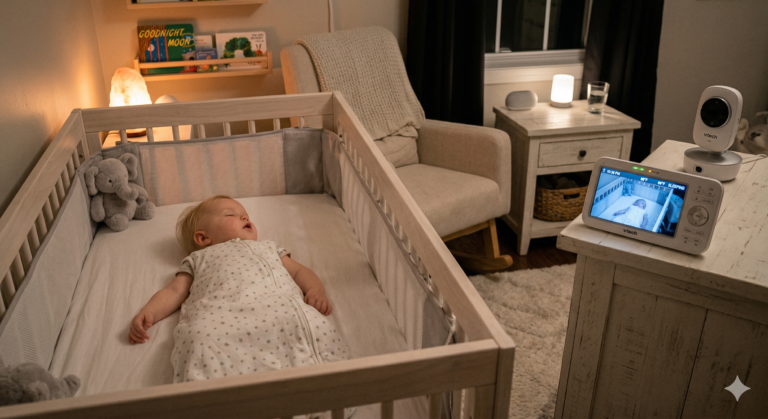
A good baby monitor also helps you actually rest between feeds without constantly checking on the baby.
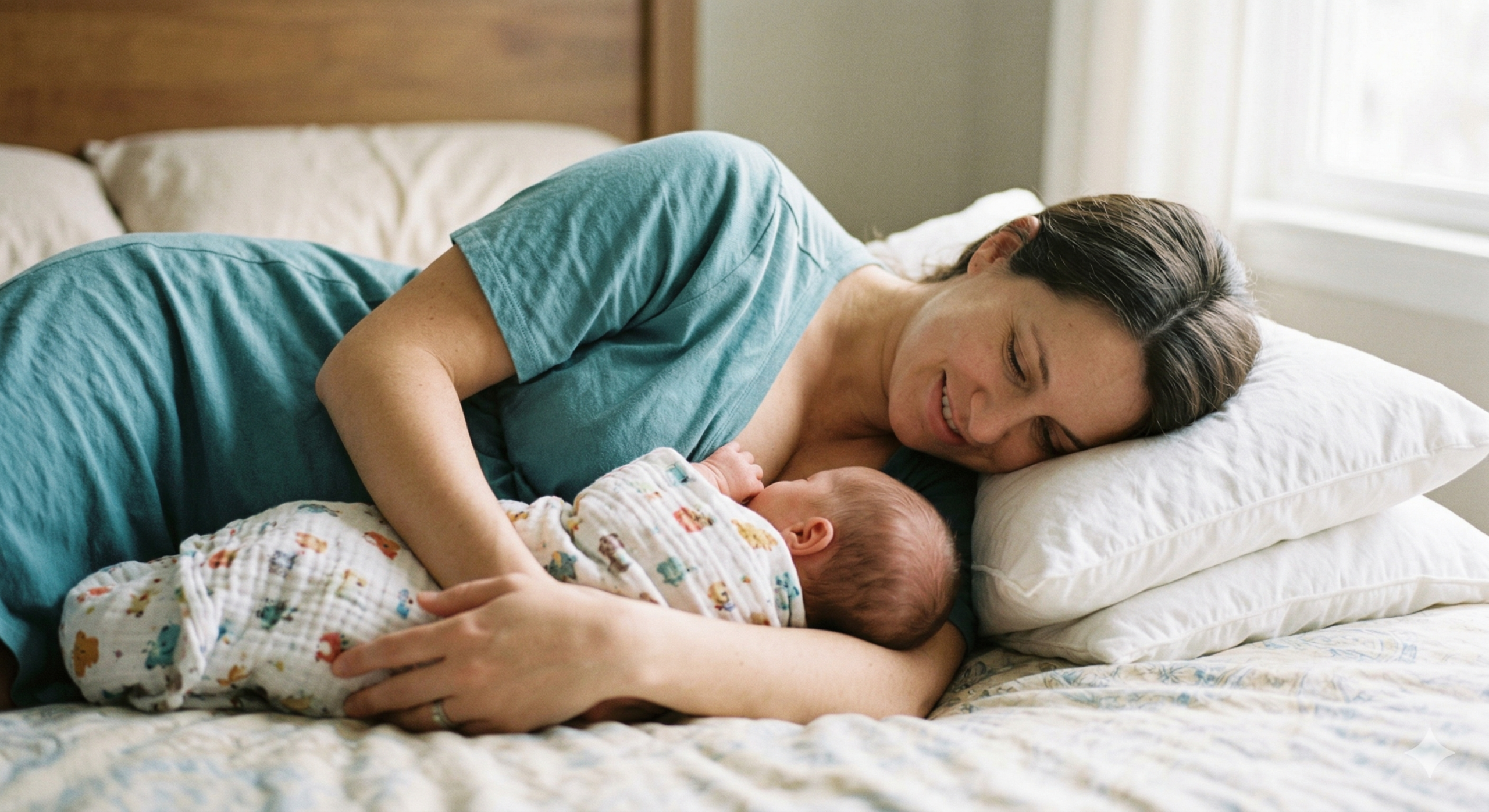
Then someone showed me the side lying breastfeeding position, and I am not exaggerating when I say it changed my life. You lie on your side in bed. Your baby lies on their side facing you, tummy to tummy. You offer the lower breast and the baby latches while you’re both lying down. Your bottom arm can go above the baby’s head or tuck under your own pillow. Your top arm rests gently on the baby or on your hip. That’s it. You’re feeding your baby while lying down.
Your body is supported. Your arms and back are free. You can actually rest. There’s something about lying there with your baby, close and quiet in the dark, that shifts the whole experience. Feeds stopped feeling like a chore and started feeling like a moment of connection. I actually started looking forward to some of those quiet night feeds — something I never thought I’d say.

But just a note of caution that you should not be in too deep a sleep as you want to be cautious of not leaning forward and potentially suffocate your baby and if you have your blanket on, make sure that it is not completely covering your baby. Your mattress should also be firm and flat and no saggy surfaces around baby.
It is ok to refuse visitors and say no to hosting family and friends when you need the rest
This was the hardest lesson. Harder than the bleeding, harder than the breastfeeding. Because it meant going against everything I’d been raised to believe about being polite, being a good host, and being grateful when people want to visit your new baby.
But I’m going to say it plainly: you do not have to host anyone after having a baby.
Not your in-laws. Not your parents. Not your best friend. Not your colleague who shows up unannounced with a teddy bear and expects a cup of tea. The people who love you will understand. Rest is not selfish – it is recovery. Your body grew a human being. It delivered that human being into the world. It is healing from something enormous. You are learning to keep a tiny person alive while running on no sleep and a tidal wave of hormones.
You are allowed to close the door. Silence your phone. Ignore the doorbell. Stay in your pyjamas. And focus entirely on yourself and your baby.
Having a Baby: What I’d Tell My Pre-Baby Self
If I could go back in time and sit down with my pregnant self, I’d say this:
Pack more maternity pads. Like, way more. And the mesh underwear? Take all of it.
Breastfeeding is going to be hard, and that’s normal. Book the lactation consultant now. Buy the nipple cream. And learn the side lying position before the baby arrives — your 3am self will thank you.
Once you’re past the newborn phase and starting solids, you’ll want to know how to go about introducing allergens to your baby safely
Set up diaper stations everywhere. It will feel excessive. It’s not. It’s survival.
Learn to say no. To visitors, to expectations, to the pressure to look like you have it all together. You don’t have to perform motherhood for anyone.
And while you’re prepping, it’s also worth figuring out how to choose a baby stroller before the baby comes — one less decision for sleep-deprived you
And most importantly: you’re going to feel like you’re failing. You’re not. Every new parent feels this way. The fact that you’re worrying about doing it right means you already are. Having a baby is the most beautiful, terrifying, exhausting, overwhelming thing you’ll ever do. Nobody can fully prepare you for it. But knowing what’s coming — even just a little — makes it a bit less lonely.


4 Comments